MAN 30N has carried many colour schemes leaving the Leyland National factory in Workington in March 1977...

©2020 Isle of Man Department of Education Sport and Culture All Rights Reserved

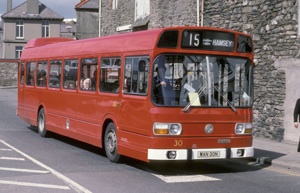
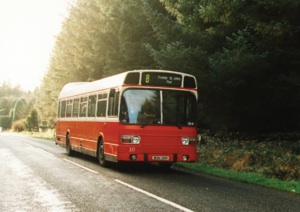
ABOVE: 27th April 1977: Isle of Man National Transport (as it was then known) No 30 (MAN 30N) is craned off the boat in Douglas. The bus is brand new state-of-the-art Leyland 'National' and is part of an order of six (nos 28 - 33) ordered by General Manager William Lambden. They join 14 similar buses already in service on the Island. Bus carries all-over "Isle of Man National Transport" bus red. (Paul Jennings)

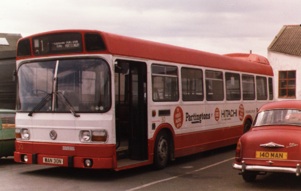
ABOVE: 1982: Bus repainted in red and white "Isle of Man National Transport" livery, complete with side advertisement for 'Partingtons' at Port Erin. NOTE: Riley 1.5 car 140 MAN that of former IMR Operations Manager Graham Warhurst. (Richard Dodge)

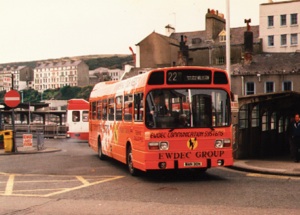
ABOVE: July 1987: At this time, many Isle of Man Transport buses have 'all-over' adverts for a variety of Island companies. No 30 received 'orange' all over advert for EWDEC group Communications. (Richard Dodge collection)


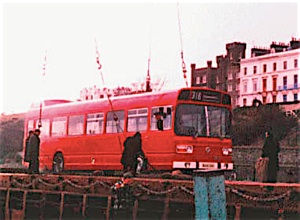
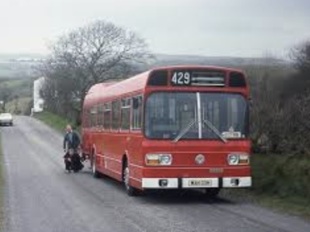
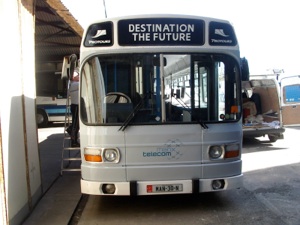
ABOVE: ON TEST having just left the Workington factory, MAN 30N pauses for adjustments.

ABOVE: October 1988: Bus repainted again, becoming one of the first buses to receive the new 'orange and cream' Isle of Man Transport livery introduced by new manager Robert Smith. FUN FACT: the ‘orange’ colour was first applied to new Leyland Olympians ordered by the Isle of Man in 1988. A brochure sent to Workington with a ‘red’ Isle of Man flag printed on it was interpreted as ‘orange’ by the manufacturer - because it was - and thus the Island’s bus fleet changed colour. And so it remained until ‘bus red’ was restored on the first OPTARE  DAFs under manager David Howard in 2000. It was not the first time random, laser-printed colours found their way, faithfully reproduced, onto an IoM bus shown elsewhere on this page.

ABOVE: Mid 1990s: Bus repainted - again in the 'orange and cream' Isle of Man Transport livery, but this time with black skirt panels. December 27th 1997: No 30 operates an enthusiast's final trip round the Island, with Les Cannan at the wheel. No 30 is the last Leyland National in service with Isle of Man Transport. Withdrawn from service. It was replaced by Dennis Dart SLF 'EasyRider' No 30 (DMN 30R) - itself now withdrawn and sold to UK. (Richard Dodge)


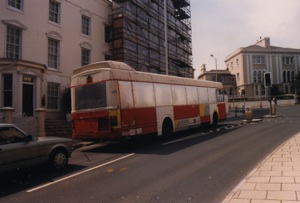
RIGHT: On Prospect Hill in the first part of 1998 showing the patchwork effect, a result of covering over windows, new white glass fibre panels, and second-hand panels removed from bus 33.

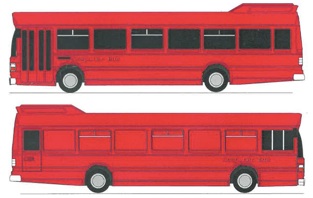
RIGHT: The first computer bus proposal created in 1997 was to return the bus to its original red, with small yellow ‘Road Services’ lettering to read ‘Computer Bus’. It was thought that multiple sponsors would be required and the offside windows were put forward as a location for individual sponsors’ adverts.

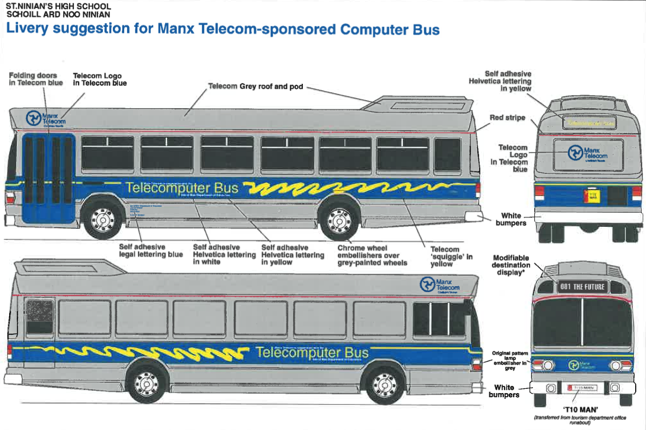
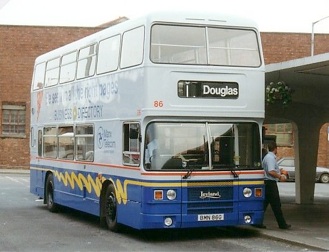
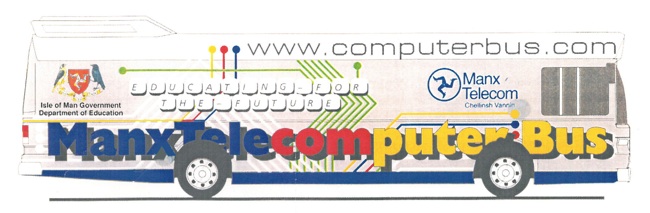
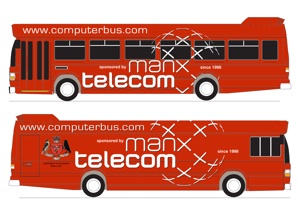
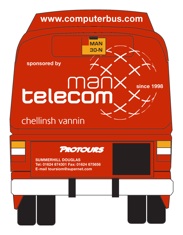
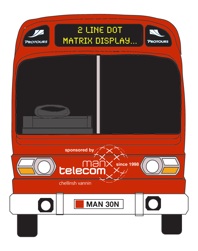
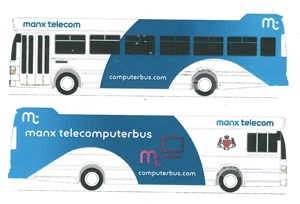
ABOVE and RIGHT: Following the generous offer from Manx Telecom to sponsor the ‘whole’ project - this scheme was devised by the ‘computer bus man’ based on an all-over advert livery carried at the time by an all-over-advert double decker MAN 86G (BELOW)

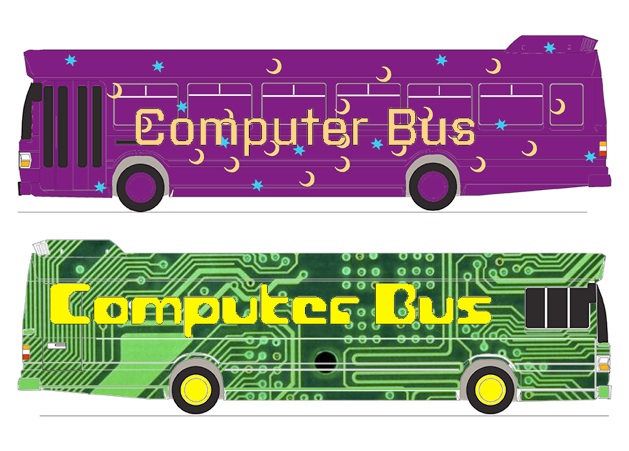
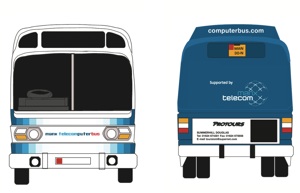
ABOVE: In the event this ‘corporate’ livery was rejected for a ‘children’s’ computer bus as being too ‘formal’ and a request was made to students at the Isle of Man College to come up with ideas.

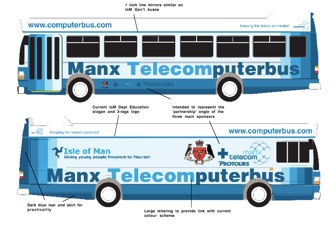
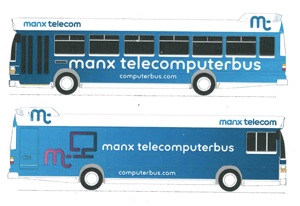
ABOVE: DES CLAGUE then of “The Creative Studio’ in Douglas was asked to devise a livery based on the College ideas and came up with the above.

The original plan was to cover over the nearside windows and have a similar scheme on both sides. As this would have left the interior of the bus without natural light or a view of the outside world, this idea was modified and the nearside windows were retained, albeit modified to feature a full set of sliding vents

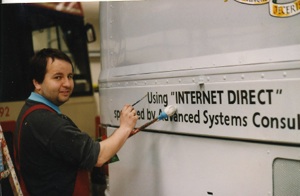
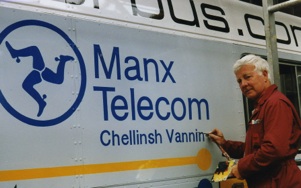
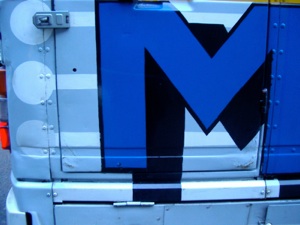
LEFT: ERIC QUIRK was Isle of Man Transport’s senior sign writer responsible for dozens of all-over adverts and more applied to the Island’s buses. Here Eric is applying the finishing touches to the MT logo. Amazingly - all of this was applied by a brush and Eric’s steady hand - none of the vinyl sticky-stuff used today !

ABOVE: Eric was ably assisted by Mike Bashforth here applying lettering to the rear of the bus.

(“INTERNET DIRECT” was an early ‘white list/black list’ web filtering service used in schools at the time, a system devised by Michael Bromwich and Phil Adcock of Advanced Systems in Castletown.)

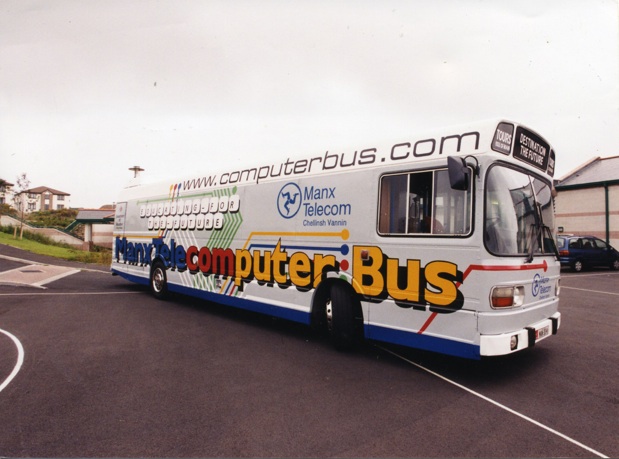
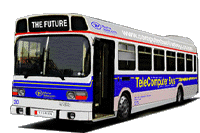
ABOVE: Official first portrait of the computer bus September 1998 in the playground at the then new Ballacottier School, Douglas.

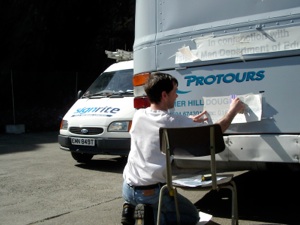
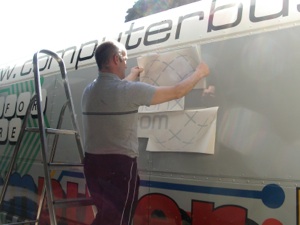
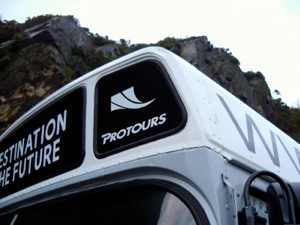
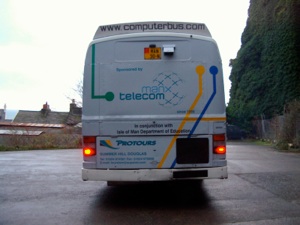
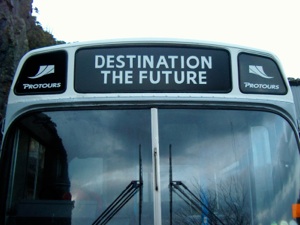
LEFT: On March 4th 2002 the computer bus received its first re-brand. Both original sponsors - Manx Telecom and Tours (IOM) had changed  - MT adopting a new logo featuring a globe to represent its world wide web credentials, and the South African coach operator ProTours had bought out our local coach operator and began applying its new colours to the Isle of  Man fleet. The original hand-painted logos were painted over - and LOWER RIGHT: Mike from Sign Sense is seen applying the new sticky-plastic logos.

After almost 10 years in 2007, thoughts turned to refurbishing the bus which was beginning to show evidence of its 30 years.

For example, a notorious weakness of the otherwise rust-resistant Leyland National bodywork is the windscreen surround. No.30 had previously been ‘repaired’ by the liberal application of mastic around the top of the windscreen (LEFT). It was likely the windscreen would need removing and new parts fitted to repair the frame.

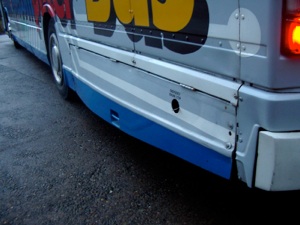
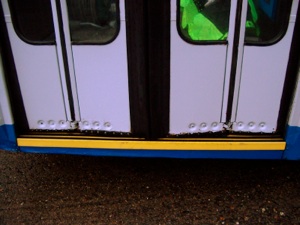
There was more rust at the seam between the one-piece roof and the front ‘dome’, and years of rainwater collecting in the bottom of the folding entrance doors had taken their toll (BELOW).

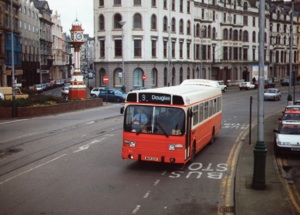
ABOVE: MAN 30N in service on Lord Street Douglas shortly after delivery. Almost every building visible in this photograph has since been demolished, the exception being the small stone-built shed to the rear of the bus, formerly part of the Steam Packet Workshops (compressor room?).

LEFT: Leyland Olympian 86 in Manx Telecom all over advertising livery, based on what was then the telecoms company corporate livery as carried by their own lorries and vans. It is seen here at Douglas Bus Station. (PHOTO: Richard Dodge)

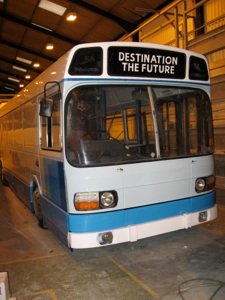
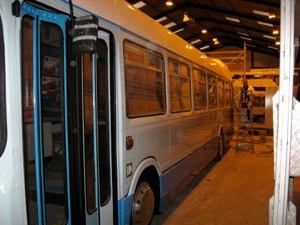
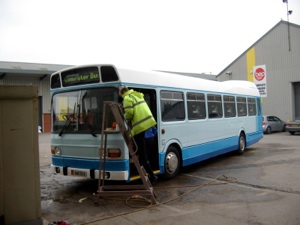
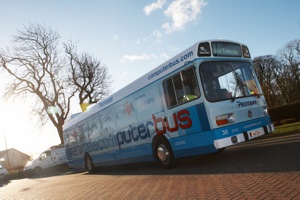
LEFT and ABOVE: At North West Bus and Coach Repairs (East Lancs) Blackburn 22nd October 2007. Work had included replacement panels - especially the replacement and rehanging of front battery and rear engine access doors, a replacement emergency door, replacement entrance doors, repair of windscreen frame, replacement window rubbers, and new wing mirrors. In addition the whole bus was given a thorough re-spray and oven bake.

In addition a McKenna Bros ‘mobitec’ dot-matrix destination was fitted (surely unique in a Leyland National?).

The lower picture shows finishing touches being applied to the vehicle prior to delivery. The computer bus man was ‘well impressed’ with the attention to detail shown by NWB&C - such things as painting the parts you couldn’t usually see such as internal access flap frames in matt black. Such a shame this company is now but a memory...
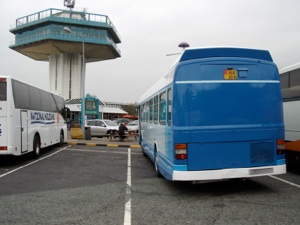
LEFT: Seen on the return from NWB&C M6 Forton Services near Lancaster - with the distinctive ‘Top Rank’ tower.
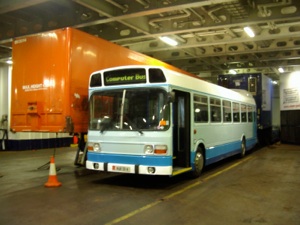
LEFT: At the bow end of the car deck of the Steam Packet’s Ben-my-Chree. Upon startup, the ancient Leyland 500-engine managed to fill most of the car deck with thick fumes, much to the annoyance of the crew...

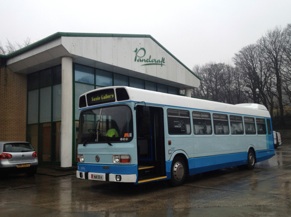
LEFT: Official launch photo of the repainted and re-lettered bus outside the Manx Telecom HQ in Braddan, December 10th 2007.

Sign writing had been carried out by Edwin Dennis and this time was of the stick-on plastic variety (compared with the original scheme from 1998).

Keen bus spotters will note that for the first time since about 1987, the bus is sporting a ‘Leyland’ whirling plug hole badge on the front. The original had been removed as part of the Ewdec all-over advert circa 1987). The new one was purchased by the computer bus man from e-Bay.

1977

1982

1987

1988

1997

1997

1998

1998

2002

2007

Another rust spot was the seam between the windscreen frame and the front corner panels. This had not been helped over the years by enthusiastic disk sanding cutting through galvanised protection prior to repaints.

The Emergency Door had also collected rainwater and been patched with filler in the past, and was looking particularly sorry for itself. Fortunately the spare parts collection included a brand new door still in primer and it was thought this could usefully be used to replace the rusted original.

At some point in the past the original engine flaps had been replaced with glass fibre replacements - hung with domestic door hinges which had rusted solid. (Access was obtained by bending the panels upwards...) Time to address this...

LEFT: The rear of the bus was also a bit ragged, with wonky bumpers and rust beginning to seep out from behind the covered-over rear window.

ABOVE: As ever the computer bus man favoured a return to the original all-over red carried by the bus when new and produced a proposal to re-instate this. As before, this was rejected.

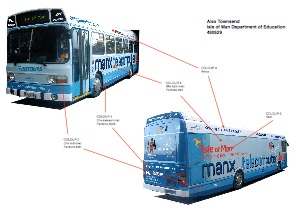
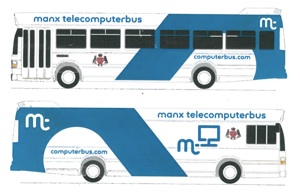
ABOVE: In the event the exercise was passed back to Manx Telecom who produced a series of proposals similar to that shown above. It was a variation of this that was accepted on both sides and the bus was duly dispatched to North West Bus & Coach Repairs (part of East Lancs Coachbuilders) in Blackburn.

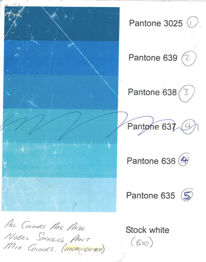
BELOW: WARNING: At the time the Manx Telecom colours were various shades of greeny/blue and a sheet indicating these was prepared by the graphic designers indicating the Pantone® numbers. Pantone is a Colour Matching System used by the printing industry - but crucially not by the motor trade...

ABOVE: This laser-printed sheet was supplied in good faith to NWB&CR as a guide. The painters saw the (random) printed colours on the sheet and dutifully matched them exactly. Not having access to Pantone® swatches - they were not to know that what was ACTUALLY required was something rather different. Thus the computer bus emerged in a blue livery which was unique - and nothing at all like the Manx Telecom corporate colours of the day.

This proved a bonus in the long term, as Manx Telecom changed its colours again a few years later, and the bus could carry these colours in its own right rather than carrying an out-of-date corporate livery,

LEFT: British Leyland badge bought by the Computer bus man from eBay for £59.95.

2015

For a number of years Manx Telecom had become  known as ‘mt’ and the previous livery carried  by the computer bus did not reflect this.

By 2015, covering vehicles in all-over plastic wraps had become common practice, allowing designers complete freedom with gradient fills and more. Thus a proposal was made to wrap the bus in a plastic skin, using one of the designs shown here.

Unfortunately, the riveted construction of the Leyland National, with thousands of bumps, nooks and crannies did not end itself to these treatments in the way modern, seamless, smooth-sided vehicles do.

As the vehicle’s quality East Lancs paintwork was still largely in ‘as new’ condition, a decision was made to strip the vinyl lettering - and apply an updated design.

(In the event the front and rear ends of the bus were resprayed by Panelcraft in Tromode.)

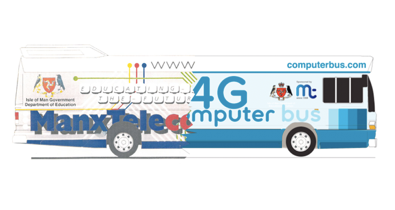
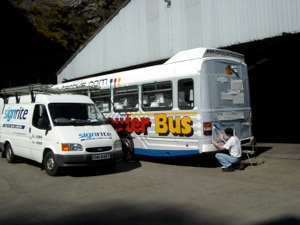
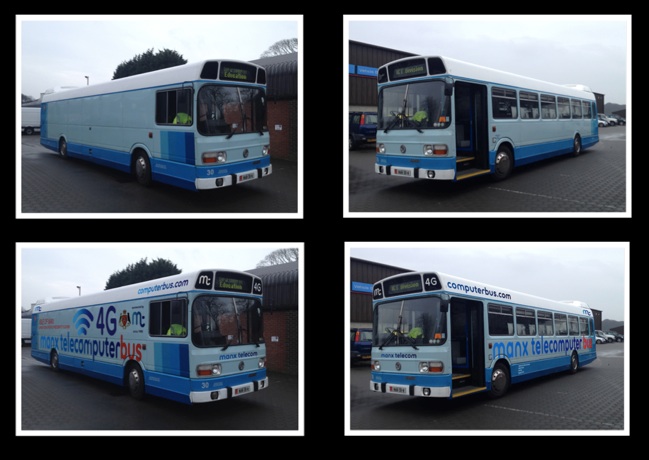
ABOVE: Photographs of the stripped vehicle with its resprayed front and rear ends were subjected to a Photoshop makeover by the computer bus man to create the images above - and it was these that were used by ‘signrite’ to create the finished product.

(NOTE: As ProTours (or Tours IOM) were no longer officially sponsors of the bus - their references disappeared from the bus after 20-years.)

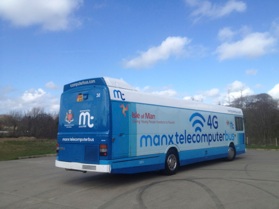
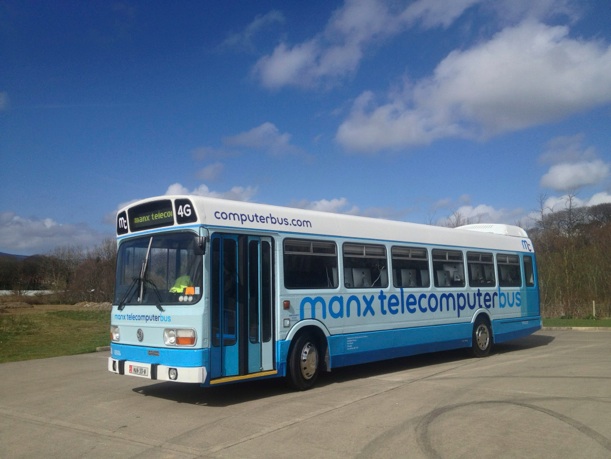
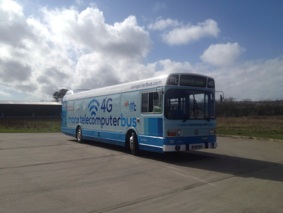
The design incorporated the new ‘mt’ logo, and bold references to the then novel ‘4G’ cellular network on the Island, a system the refurbished bus was set to take full advantage of.

One significant difference between the mock-ups and the finished bus was that the word ‘bus’ was to appear in blue and not red.

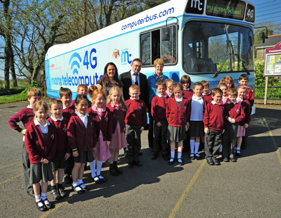
ABOVE: April 22nd 2015 saw the official relaunch of the bus with its new ‘4G’ scheme and lettering using the ‘ultima’ typeface now in use by ‘mt’. The event took place at Kewaigue School.

Prior to re-branding, the front and rear of the bus was resprayed by Panelcraft at Tromode, the only place on the Island with a big enough ‘oven’ to bake a large vehicle like the computer bus - albeit one end at a time...

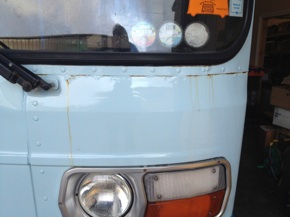
ABOVE: BEFORE: Rust creeping from the windscreen frame.

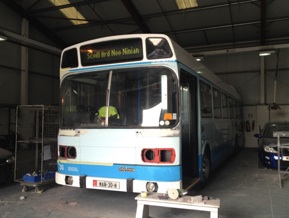
ABOVE RIGHT: Inside Panelcraft with the front of the bus stripped down prior to respray.

RIGHT: Outside Panelcraft after completion.

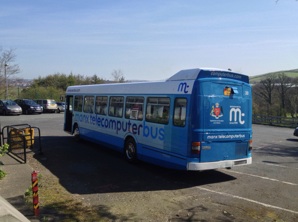
ABOVE: April 15th 2015 saw the bus at White Hoe Douglas to photograph what would likely be its final paint scheme.